
In Search of the Fastest TypeScript ORM
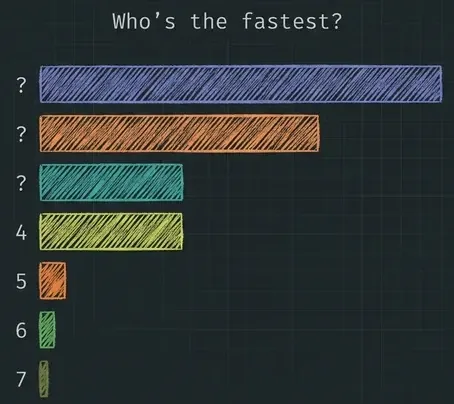
I kept seeing “just use Drizzle, it’s lightweight” and “ORMs are slow, use a query builder” repeated everywhere. So I decided to actually measure it.
Pure SQL generation speed — no database, no network, no connection pool. Just the overhead your ORM adds to every single request.
7 entries. 8 query types. 3 runs averaged. Apple Silicon M4.
Methodology
Section titled “Methodology”- Environment: Node.js v24, Apple Silicon M4, 3 runs averaged.
- Versions: Latest stable of every ORM/QB as of March 2026.
- Fairness: Each ORM uses its most idiomatic API — QueryBuilder for TypeORM/MikroORM, which benefits them by skipping entity overhead.
- What’s measured: Pure SQL string generation — no database, no I/O, no connection pool. This isolates ORM overhead only.
- Why no Prisma? Prisma is not a pure TypeScript/JavaScript ORM — only its client is JS/TS. The query engine is a separate Rust binary that builds SQL, making it architecturally incomparable and not even testable this way.
The Results
Section titled “The Results”INSERT — 10 rows in batch
Section titled “INSERT — 10 rows in batch”| Entry | ops/sec | vs winner |
|---|---|---|
| UQL | 606K 🥇 | — |
| Knex | 407K | 0.67x |
| Sequelize | 202K | 0.33x |
| Kysely | 197K | 0.33x |
| MikroORM | 50K | 0.08x |
| TypeORM | 47K | 0.08x |
| Drizzle | 13K | 0.02x |
UPDATE — SET + WHERE
Section titled “UPDATE — SET + WHERE”| Entry | ops/sec | vs winner |
|---|---|---|
| UQL | 1,817K 🥇 | — |
| Kysely | 819K | 0.45x |
| Knex | 601K | 0.33x |
| TypeORM | 321K | 0.18x |
| Sequelize | 234K | 0.13x |
| MikroORM | 119K | 0.07x |
| Drizzle | 81K | 0.04x |
UPSERT — ON CONFLICT by id
Section titled “UPSERT — ON CONFLICT by id”| Entry | ops/sec | vs winner |
|---|---|---|
| UQL | 693K 🥇 | — |
| Knex | 349K | 0.50x |
| Sequelize | 334K | 0.48x |
| Kysely | 334K | 0.48x |
| TypeORM | 316K | 0.46x |
| MikroORM | 130K | 0.19x |
| Drizzle | 38K | 0.05x |
DELETE — simple WHERE
Section titled “DELETE — simple WHERE”| Entry | ops/sec | vs winner |
|---|---|---|
| UQL | 3,642K 🥇 | — |
| Sequelize | 1,349K | 0.37x |
| Kysely | 1,290K | 0.35x |
| Knex | 962K | 0.26x |
| TypeORM | 542K | 0.15x |
| Drizzle | 212K | 0.06x |
| MikroORM | 148K | 0.04x |
SELECT — 1 field
Section titled “SELECT — 1 field”| Entry | ops/sec | vs winner |
|---|---|---|
| UQL | 3,994K 🥇 | — |
| Sequelize | 3,143K | 0.79x |
| Kysely | 1,559K | 0.39x |
| Knex | 994K | 0.25x |
| TypeORM | 817K | 0.20x |
| MikroORM | 297K | 0.07x |
| Drizzle | 238K | 0.06x |
SELECT — WHERE + SORT + LIMIT
Section titled “SELECT — WHERE + SORT + LIMIT”| Entry | ops/sec | vs winner |
|---|---|---|
| UQL | 1,200K 🥇 | — |
| Knex | 480K | 0.40x |
| Kysely | 425K | 0.35x |
| Sequelize | 385K | 0.32x |
| TypeORM | 355K | 0.30x |
| Drizzle | 60K | 0.05x |
| MikroORM | 46K | 0.04x |
SELECT — Complex $or + operators
Section titled “SELECT — Complex $or + operators”| Entry | ops/sec | vs winner |
|---|---|---|
| UQL | 644K 🥇 | — |
| Kysely | 218K | 0.34x |
| Knex | 199K | 0.31x |
| TypeORM | 186K | 0.29x |
| Sequelize | 152K | 0.24x |
| Drizzle | 35K | 0.05x |
| MikroORM | 22K | 0.03x |
AGGREGATE — GROUP BY + COUNT + HAVING
Section titled “AGGREGATE — GROUP BY + COUNT + HAVING”| Entry | ops/sec | vs winner |
|---|---|---|
| UQL | 1,489K 🥇 | — |
| Sequelize | 407K | 0.27x |
| TypeORM | 364K | 0.24x |
| Knex | 284K | 0.19x |
| Kysely | 227K | 0.15x |
| Drizzle | 77K | 0.05x |
| MikroORM | 64K | 0.04x |
Three Things That Surprised Me
Section titled “Three Things That Surprised Me”1. The “lightweight” query builder is the slowest thing in the benchmark.
Drizzle — marketed as lightweight — is slower than Sequelize (a full ORM from 2014) in every single category. The functional expression-tree approach creates more intermediate objects than Sequelize’s simple string concatenation.
2. Standalone query builders can’t beat a well-designed ORM.
Knex and Kysely have zero entity/relation overhead. They’re just SQL string builders. Yet UQL — a full ORM with entities, relations, and migrations — is faster than both in all 8 categories. This 4x-40x overhead advantage demonstrates that the conventional wisdom (“ORMs are slow”) doesn’t hold when the ORM is designed for performance with a Zero-Allocation architecture from day one.
3. MikroORM pays double.
MikroORM uses Knex internally as its SQL generator. So every query goes through two compilation layers: MikroORM → Knex → SQL string. The result? MikroORM averages 4-5x slower than Knex alone. That’s the cost of layering abstractions.
How UQL Gets There
Section titled “How UQL Gets There”I got curious why the gap was so large, so I dug into the approach. Most ORMs figure out your schema at query time: “What table does User map to? What column is companyId? Is it nullable?” — they answer these questions on every single query.
UQL answers them once at startup. Field-to-column mappings, table names, relation paths — all pre-computed into lookup tables before the first query runs. At query time, generating SQL is just reading from a cache.
The other difference is allocation. When TypeORM builds a SELECT, it creates a QueryBuilder, then an expression tree, then walks the tree to produce SQL. UQL pushes SQL fragments directly into a string buffer — no intermediate objects, no garbage collection pressure.
Does This Matter in Production?
Section titled “Does This Matter in Production?”Database latency is 1-50ms. ORM overhead is microseconds. So who cares?
You care at scale. If you’re running a moderately busy API — say 1,000 req/s:
- UQL adds 1 CPU-second of ORM overhead
- MikroORM adds 20 CPU-seconds — for the same queries
That’s 20x more CPU burned on generating SQL strings — pure waste before a single byte hits the network. In serverless (where you pay per ms), that’s your bill. In containers, that’s your horizontal scaling cost.
Reproduce It
Section titled “Reproduce It”Full disclosure: I’m the author of UQL. That’s exactly why I built the benchmark as an independent repo anyone can audit and reproduce.
The full benchmark is open source — clone it, audit it, run it, share results. No database needed, finishes in seconds. See how UQL maintains its 4x-40x performance lead across every modern TypeScript environment.
Repo: ts-orm-benchmark